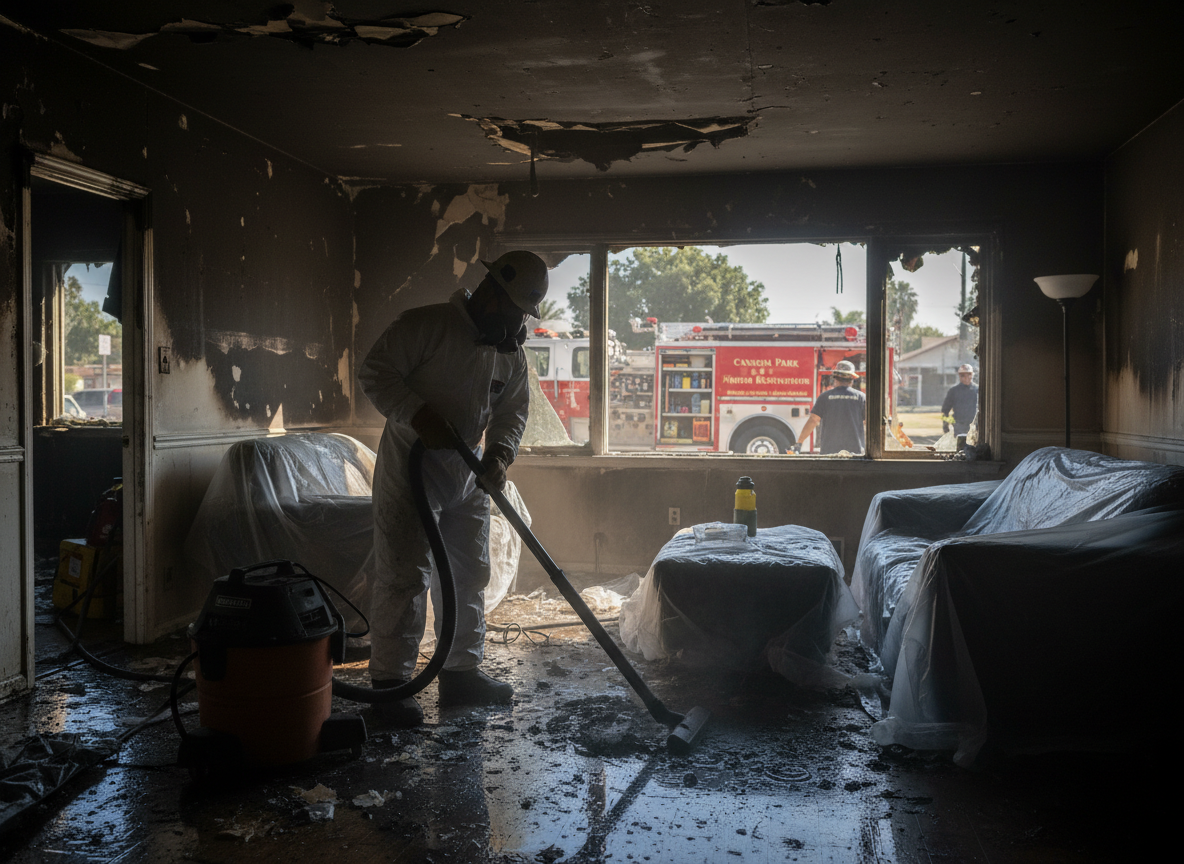
Canoga Park homes built in the 1950s through 1970s often feature wood framing and stucco exteriors that allow smoke to travel through attics and wall cavities during hot, dry summer months when fire risk peaks. Emergency fire damage restoration starts with rapid assessment of hidden char and soot layers that standard cleaning misses, especially in single-story ranch houses common near Pierce College. Los Angeles County building codes require removal of all affected drywall and insulation once char depth exceeds surface level, and crews must seal HVAC systems immediately to prevent redistribution of particulates into Warner Center offices or nearby Woodland Hills residences.
Hot Mediterranean summers accelerate drying of charred wood, which can lead to hidden ember flare-ups days after the initial event if moisture from suppression water is not extracted from crawl spaces. In neighborhoods like Chatsworth and Winnetka, older electrical systems increase the chance of secondary faults during restoration when power is restored too soon. Technicians test for pH levels in soot on concrete slabs typical of local construction, because alkaline residues etch surfaces if left untreated before repainting.
Water used by Los Angeles County fire crews saturates insulation in ceilings of two-story homes near Westfield Topanga, creating conditions for mold within 48 hours if not dried with industrial equipment. Emergency protocols include negative-air machines and HEPA filtration to protect adjacent units in multi-family buildings common along Saticoy Street. Salvage decisions on kitchen cabinets or hardwood floors depend on smoke penetration depth, which varies by fuel type burned in each incident.
Technician insight
In Canoga Park, the thing that catches most people out with emergency fire damage restoration is how quickly smoke travels through the open attic spaces in 1960s ranch houses during our hot dry summers. Homeowners often focus only on the room where the fire started and miss the fine soot that settles on everything from Warner Center to Winnetka once the HVAC kicks back on.
Attic soot migration after kitchen fire
A kitchen fire in a single-story Canoga Park home sent smoke through the attic shared with the garage. Inspection showed heavy soot on insulation and rafters extending into two bedrooms. Crews removed affected insulation, cleaned all surfaces, and ran negative air machines for three days until air tests cleared. The family returned without lingering odors.
How it works
- 1
Initial Assessment
Technicians arrive within hours, document all affected rooms, and test for hidden smoke migration through attics and ductwork in Canoga Park homes.
- 2
Containment and Safety
Plastic barriers and negative pressure isolate the work zone to stop soot spread into unaffected areas like living spaces near Warner Center.
- 3
Removal and Cleaning
Charred materials are removed, surfaces are cleaned with appropriate agents, and HVAC systems receive full decontamination.
- 4
Drying and Monitoring
Moisture from fire suppression is extracted and tracked with meters until levels return to normal before any reconstruction begins.
- 5
Final Verification
Air quality and surface tests confirm the property meets clearance standards for safe re-occupancy.
Pricing
Pricing is determined after on-site inspection because each fire affects different materials and square footage.